
Finding Sashiko
My interest in sashiko was first sparked by a simple cloth like this hanafukin in the home of my in-laws. The geometric patterns of sashiko, a combination of complexity and simplicity, struck a chord in me. This pattern in particular, asanoha, or hemp leaf in English, was to become a particular favourite over time.
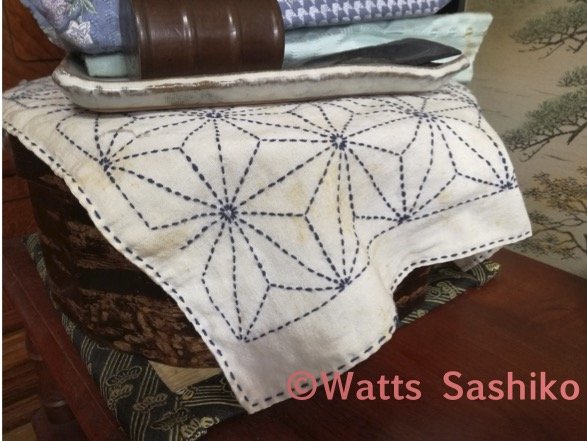
My in-laws lived in Tohoku, the northern region of Japan most strongly associated with the origins of sashiko. During my travels there in the early nineties I occasionally came across it and was curious, but for a long time knew little more. I used to wonder why craftwork so beautiful could not be found not sold alongside other folk craft items in souvenir shops.
Those early years of my life in Japan days were pre-internet, and I was I living in urban rural Japan, not Tokyo, where there were no big department stores or bookshops (let alone English ones). Information was hard to come by and I didn’t have the spoken language skills or literacy available to me now to probe deeper. But I kept my eyes open and eventually found sashiko kits for sale, but these were few and far between, as strange as that may seem, for sashiko was nowhere near as popular then as it is now. in fact I often received bemused looks when I told Japanese people I enjoyed doing sashiko, because it was regarded as something that old ladies in rural areas did, not a hobby for a young foreign woman. Certainly nobody in my circle of acquaintances of young mothers did sashiko.
I enjoyed doing the kits. They were easy to follow and gave me a chance to learn different patterns. But I used the needle the only way I knew how, with little idea of what I was doing or the depth of the tradition that I had started to dip my toe in. I also used to search for books , but could find barely anything in Japanese or English. (Several decades on I am still astonished at how few books on sashiko are published in Japan, compared to the numerous publications available on cross stitch or European styles of embroidery.)
I persisted with doing kits sporadically for years, eventually even finding a book or two in English and moved on to drafting my own designs on to fabric. The turning point for me came when I met a teacher—quite serendipitously by accident— and joined the sashiko group she ran. By then I could read, write and speak Japanese, so I was all prepared to make the most of the opportunity to learn as the doors to a new world of sashiko opened up to me.
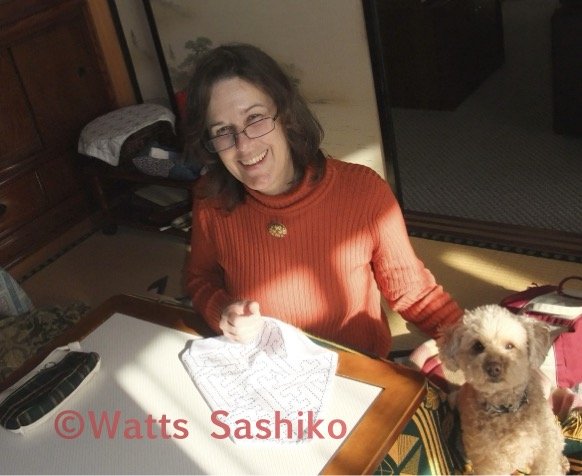
Nothing beats sitting tucked up in a warm kotatsu (heated table) with my faithful friend doing sashiko!
Sashiko is simple, but it has depth. I think that is why I have never tired of or grown bored with it. There is always something more to stitch or learn. Discovering sashiko all those decades ago has enriched my life in more ways than I ever could have imagined. In Japan it was a gateway for experiences that taught me so much about Japanese life, culture and history, and now that I am back in Australia again, with this unique set of experiences and knowledge, I look forward to shaping my life here and forging new relationships through sashiko!